


Shenzhou 6 was China’s second manned space flight. It carried two Taikonauts (Chinese Astronauts) Nie Haisheng and Fei Junlong and was a milestone for China’s space program and proof that the country is completely capable of carrying out its own space program independently.

The successful spaceflight demonstrated:
1. The progress of China’s space technology.
2. Enhanced China’s prestige in the world and promoted China’s economic, scientific and national defense capabilities.
3. Inspired patriotism and national cohesiveness.
4. Fostered the interests of people in China’s vast rural regions on science and technology.
5. Chinese scientists mastered the technology for a multi-person, multi-day space mission.
6. Marked China’s commitment to becoming a global space power.
7. Shenzhou 6 mission was a major step forward in China’s ambition of building a space station and probing the moon. Shenzhou spacecraft was used to develop manned spaceflight techniques which in the future would serve as a ferry to Chinese space stations and as a lunar orbital and landing spacecraft.
The Mission
Chinese astronauts Fei Julong and Nie Haisheng were launched into space on China’s second manned spacecraft at 9:00 am October 12, 2005 (Chinese local time) from Jiuquan Satellite Launch Center on a Long March 2F. It was the 88th launch and the 46th consecutive successful lift-off of China’s Long March rockets series.
The two Chinese Astronauts conducted a series of experiments on the spacecraft, including manoeuvres between the orbital module and re-entry capsule, taking on and off space suits, using a space toilet and a blood pressure self-test. The experiments and data returned were useful in exploring and understanding how astronauts adapt to the spaceflight environment for future human space exploration. The Shenzhou 6 spacecraft orbited the Earth in a 213 miles (343 km) orbit.
The Taikonauts nearly spent five days (4 days, 19 hours, 32 min) in space during their mission and completed 76 circles around the earth. The total flight time of Shenzhou 6 was 115 hours and 32 minutes. It ran more than five times that of the Shenzhou 5 mission of 2003 (two years before), which put the first Chinese Taikonaut in space.
Shenzhou 6 Taikonauts (Chinese Astronauts)
The two Chinese Astronauts, both were former fighter pilots.
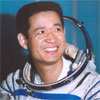 Nie Haisheng
Nie Haisheng, the Chinese astronaut was born in Yangdang town of Zaoyang, Hubei Province on October 13, 1964. After graduating from high school he joined the People’s Liberation Army Air Force, became a fighter pilot and has reached the rank of Lieutenant Colonel. In 1998 he was selected for the astronaut program. He was one of three astronauts who were part of the final group to train for the Shenzhou 5 flight. Yang Liwei was picked for the flight
He is married to Nie Jielin and has a daughter.
 Fei Junlong
Fei Junlong was born 1965 in Suzhou, Jiangsu province of China. He joined the People’s Liberation Army Air Force (PLAAF) in 1982 at the age of 17 and was a fighter pilot. He was selected to be an astronaut in 1998.
He married Wang Jie in 1991 and has one son.
Shenzhou Spacecraft
China’s Shenzhou spacecraft uses a basic design from Russia’s Soyuz spacecraft, but is tailored with new systems and equipment. The spacecraft consists of a primary crew-carrying re-entry capsule, an orbital module and a service module. China spent 110 million US dollars (900 million Yuan) on Shenzhou 6 spacecraft.
Shenzhou 6’s orbital module reportedly contains experiments and equipment, a food heater and other new equipment to be tested on this flight. It carried its own solar arrays and could stay in Earth orbit for a prolonged period. While the re-entry module and the Shenzhou 6 crew returned to Earth, the spacecraft’s orbital module is still in orbit.
The following are some key moments during the space mission of Shenzhou 6:
Wednesday, October 12, 2005 | |
| 05:30 | An expedition ceremony is held for Fei Junlong and Nie Haisheng, the two Chinese astronauts for Shenzhou-6 spacecraft, the country’s second manned spacecraft. Chinese Premier Wen Jiabao wishes them success in their mission. |
| 06:15 | The two Chinese astronauts board Shenzhou 6 and the spacecraft gets ready for lift-off. |
| 09:00 | The Shenzhou-6 spacecraft blasts off from the Jiuquan Satellite Launch Center. |
| 09:00:04 | The rocket soars into the sky four seconds after ignition. |
| 09:09:43 | The spacecraft separates from the rocket and enters its orbit at an altitude of 200 km. |
| 09:09:52 | The Shenzhou-6 manned spacecraft enters preset orbit. |
| 09:34 | Astronauts report normal physical conditions. |
| 09:39 | Commander of the spaceflight Chen Bingde announces success of the launch of the Shenzhou-6 manned spacecraft. |
| 09:43 | Chinese Premier Wen Jiabao delivers an important speech at the Jiuquan Satellite Launch Center. |
| 10:31 | The Kashi monitoring and control station detects the Shenzhou 6 spacecraft, which begins its second round of flight. |
| 11:05 | Astronauts take their first meal in space. |
| 15:54 | The Beijing Aerospace Control Center gives instructions to the spacecraft to perform orbit manoeuvre. |
| 16:00 | Orbit shift succeeds. |
| 17:31 | Fei Junlong enters the orbital module and Nie Haisheng gives a thumb-up to the camera. |
| 21:32 | The two astronauts have conversations with their family members. Fei thanked his family for their support and made plans to go fishing with his son Fei De, who asked how the astronaut felt in weightlessness. Nie spoke to his wife and listened to a birthday song from his daughter. |
| 21:39 | The conversations with family members come to an end. |
Thursday, October 13, 2005 | |
| 04:16 | Fei Junlong wakes up from sleep that lasts seven hours and 8 minutes and returns to working position in the re-entry capsule from the orbital capsule. |
| 05:55 | Nie Haisheng takes off the pressure suit and puts on the blue uniform again. |
| 09:17 | Fei Junlong washes face with a piece of wet tissue. |
| 19:00 | Fei Junlong completes the day’s work and enters orbital module for sleep, which lasts seven hours and 35 minutes. |
Friday, October 14, 2005 | |
| 05:56 | Shenzhou 6 spacecraft performs first orbit maintenance during the 30th orbiting after the orbit shift, which moves itself back to the preset orbit. |
| 06:19 | Ground monitoring and astronauts’ report show the orbit maintenance is successful. |
| 14:36 | Astronauts video record images of the earth through the porthole. |
| 16:30 | Fei Junlong makes somersault for four times continuously. |
Saturday, October 15, 2005 | |
| 16:28 | Chinese President Hu Jintao has conversation with Fei Junlong and Nie Haisheng. |
| 16:33 | Hu’s conversation with astronauts ends. |
| 18:05 | Fei Junlong and Nie Haisheng send images of the solar panels of the spacecraft to Beijing Aerospace Control Center. |
Monday, October 17, 2005 | |
| 03:59 | Astronauts put on pressure suits and fasten themselves to the seats. |
| 04:02 | Astronauts report that the spacecraft is working normally and they are feeling good. |
| 04:07 | The propulsion module separates from re-entry capsule successfully. |
| 04:13 | The spacecraft enters blackout zone. |
| 04:20 | The primary parachute is unfurled and staff aboard search helicopters see the module. |
| 04:32 | The module touches down and Taikonauts report they feel good. |
| 04:33 | Retro-rockets ignite and the module lands successfully on the spot that was only one kilometre away from the pre-planned place. They landed in the grasslands of north China’s Inner Mongolia Autonomous Region. |
| 04:53 | Helicopters arrives around Shenzhou 6’s landing spot where the module was standing vertical. |
| 05:38 | Taiknonaut Fei Junlong climbs out of the module, waving his right hand to the cheering crowd. |
| 05:39 | Taikonaut Nie Haisheng climbs out of the module. |
Note: On the Sunday 16th the Taikonauts prepared to return back to Earth.
Events after Landing
Fei and Nie climbed out the capsule with the help of technicians. They were seated for a bouquet of flower and to get used to Earth’s gravity. They later had several pieces of chocolate and Chinese herbal tea. Nie seemed to have a very good appetite and had a bowl of instant noodles.
The two men were then flown to Beijing, where they received big hugs from their wives, children and colleagues and were greeted with a grand welcome ceremony attended by senior military officers and Yang Liwei, the first Chinese taikonaut that piloted the Shenzhou-5.
Television pictures showed the parents of the two Taikonauts burst into tears when they saw their sons emerging from the spacecraft early Monday morning. Jubilant residents in the hometowns of the Taikonauts set off firecrackers and performed traditional lion dances. Messages of congratulations were sent from around the world.
Did you know?
* China, Russia and the United States are the only countries that have launched humans into space. China is the third nation to independently launch a human into orbit. Shenzhou 7 will be launched in 2008.
* Shenzhou 5, China’s first manned spaceflight launched astronaut Yang Liwei on a 21 hour mission on October 15, 2003. During the Shenzhou 5 mission, Yang spent the entire time in the spacecraft’s crew compartment and strapped in his chair as part of the test flight.
* During the first Chinese spaceflight (Shenzhou 5) in 2003, Lone Taikonaut Yang Liwei never left his seat in the re-entry module or took off his space suit, whereas in Shenzhou 6 Fei Junlong and Nie Haisheng entered the orbit cabin from the re-entry module, took off their cumbersome space suits and put on ordinary work clothes that make movement more convenient.
* Fei and Nie had a far wider range of food available to them on this flight than Yang. About 88 pounds (40 kgs) of food rode into orbit aboard Shenzhou 6 to provide three meals of up to six dishes each. While rice was the stable, beef cooked in orange peels and vegetables were also on the menu along with coffee, green tea, orange juice and other fruits.
Related Books
- The Chinese Space Programme: From Conception to Future Capabilities by Brian Harvey
from Amazon.com - The Chinese Space Program: A Mystery Within a Maze (Orbit: A Foundation Series) by Joan Johnson-Freese
from Amazon.com and Amazon.co.uk
Also try Abebooks in the space books section – it is great for second hand books or even auction sites like eBay.com and eBay.co.uk.
Shenzhou 6 Links:
- China spends 110 million US dollars on Shenzhou-6 spacecraft: from People’s Daily Online.
- Key moments in Shenzhou-6 spaceflight:
- Shenzhou VI: China’s Second Manned Mission:
- Taikonauts step down from Shenzhou-6: Picture Source
Looking for a Space Gift? Try Space Books, astronomy software, magazines, Star Wars Dvd, toys, posters, cheap air flightsand more.
Any comments or suggestions, then click on Contact Info.


. It was a milestone for China's space program.)
You must be logged in to post a comment.