


NASA’s AIM spacecraft is studying the highest and most mysterious clouds on Earth. AIM stands for ‘Aeronomy of Ice in the Mesosphere’. It was launched from Vandenberg Air Force Base, California on April 25, 2007 aboard a Pegasus XL rocket. AIM is the seventh Small Explorers mission under NASA’s Explorer Program.

The AIM spacecraft features three instruments designed to study Polar Mesospheric Clouds (PMCs) located at the edge of space, 50 miles above the Earth’s surface in the coldest part of the planet’s atmosphere. PMC’s are also known as noctilucent clouds.
The mission’s primary goal is to explain why these clouds form and what has caused them to become brighter and more numerous and appear at lower latitudes in recent years. AIM’s results will provide the basis for the study of long-term variability in the mesospheric climate and its relationship to global climate change.
Mission
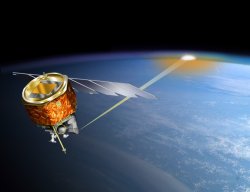 The AIM mission was selected in July 2002 with final approval in May 2004. In mid-2003, Orbital Sciences Corporation was awarded the satellite manufacturing contract for the AIM spacecraft from a university team led by Hampton University with the University of Colorado’s Laboratory for Atmospheric and Space Physics (LASP) managing satellite development.
Mating of the three stages of the Orbital Sciences Pegasus XL was underway at Vandenberg in March 2007. AIM underwent a series of readiness tests to verify its state of health and the instruments were cleaned and calibrated. Technicians also partially deployed the craft’s solar arrays for illumination testing.
AIM was mated to the Pegasus XL during the second week of April, after which final inspections were conducted.
Two days before launch, the Pegasus rocket with the AIM spacecraft was transported to the Vandenberg runway where it was attached beneath the Orbital Sciences L-1011 carrier aircraft.
The expected mission life of AIM was 26 months. As of June 2017, Aim satellite is still operational.
Spacecraft:
Orbital Sciences Corporation (OSC) of Dulles, Virginia, USA is the prime contractor to Hampton University (Center for Atmospheric Sciences/Hampton University) for the spacecraft and payload integration. The AIM mission employs the LeoStar-2 bus of OSC, a 3-axis stabilized zero momentum platform. The Spacecraft structure (cylinder) has a diameter of 1.09 m and a length of 1.4 m. Spacecraft power = 335 W (orbital average) using a fixed GaAs solar array; S/C mass = 210 kg, design life of at least 2 years.
The AIM satellite has three instruments aboard: CIPS, SOFIE and CDE.
1. CIPS is an instrument that will take images of the clouds to determine when and where they form, and to document what they look like.
2. SOFIE will measure the temperature and composition of the mesosphere, which will tell scientists more about the chemistry and movement of air in the mesosphere that might lead to cloud formation or cloud dissipation.
3. CDE will measure how much dust enters the mesosphere from meteors. It is possible that this dust is what water vapor is freezing onto to form PMC’s and thus meteor dust is an important component of cloud formation to understand.
About
Hampton University (HU) is NASA’s main contractor for the AIM mission.
The Explorers Program Office at Goddard Space Flight Center, Greenbelt, Md. manages this NASA-funded mission. The Center for Atmospheric Sciences at Hampton University, Hampton, Virginia leads the mission. The Laboratory for Atmospheric and Space Physics at the University of Colorado, Boulder built two of the spacecraft’s three instruments, manages the mission and controls the satellite after launch. The Space Dynamics Laboratory of Utah State University, Logan, built the third instrument. Orbital Sciences Corporation, Dulles, Virginia designed, manufactured and tested the AIM spacecraft.

AIM Logo
Did you know?
* NASA’s SMEX (Small Explorer) program is designed to provide frequent, low-cost access to space for a variety of missions.
* Noctilucent or “night-shining” clouds were first seen in 1885 about two years after the powerful eruption of Krakatoa in Indonesia, which hurled plumes of ash high into Earth’s atmosphere. Crews aboard the International Space Station routinely witness noctilucent clouds when flying over Australia and the tip of South America.
Books:
The Chilling Stars: The New Theory of Climate Change by Henrik Svensmark
from Amazon.com, Amazon.co.uk, Amazon.ca
Explains the theory that sub-atomic particles from exploded stars have more effect on the climate than manmade CO2. The conclusion stems from Svensmark’s research which has shown the previously unsuspected role that cosmic rays play in creating clouds.
Aim Spacecraft Links:
AIM Satellite Mission – Hampton University
Mission to target highest clouds: BBC.co.uk
Strange Clouds: by NASA
Mission Description Noctilucent Clouds: Orbital ATK Pdf
Looking for a Space Gift? Try Space Books, magazines, toys and posters.
Any comments or suggestions, then click on Contact Info.


You must be logged in to post a comment.