


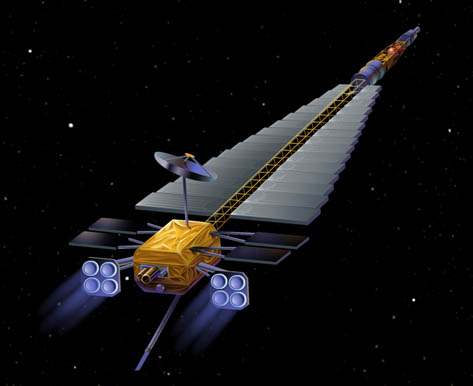
Jupiter Icy Moons Orbiter spacecraft (JIMO) is a Planet Jupiter robotic explorer. It will orbit the three Jovian moons: Callisto, Ganymede and Europa between 2015-2020. JIMO is the first NASA mission using nuclear electric propulsion and the first mission of Project Prometheus.
The aim of the mission is:
1. To explore the three icy moons of Jupiter – Callisto, Ganymede, and Europa for their potential for sustaining life, to determine if the moons have subsurface oceans and to locate potential future landing sites by determining the thicknesses of ice layers.
2. To investigate the origin and evolution of the moons, determine the makeup of interior structures, surface features and chemical composition of the moons.
3. To study the interactions between entire Jupiter system and atmospheres and interiors of the moons.
4. To determine the radiation environments around these moons and the rates at which the moons are weathered by material hitting their surfaces.
5. To develop a nuclear reactor and show that it can be processed safely and operated reliably in deep space for long-duration deep space exploration.
About the Spacecraft
JIMO is a nuclear reactor-powered spacecraft. It will use a form of electric propulsion called ion propulsion, which will allow the spacecraft to orbit each moon, making thorough observation and mapping possible. The nuclear reactor will be positioned in the tip of the spacecraft behind a strong radiation shield protecting sensitive probe equipment. The scientific instrument suite will be on the opposite tip and electric thrusters in the middle along with a radiator.
The orbiter will have 100 times more usable onboard power from the nuclear reactor than any of the current interplanetary spacecraft. This will enable the science instruments to gather more and higher quality data and to send it back to Earth at much higher data rates.
New revolutionary technologies will be required for the spacecraft. These include advanced electric propulsion, radiation hardened electronics and materials, power conversion and heat rejection technology and advancements in telecommunications.
Jimo Spacecraft Specifications:
Total Launch Mass: 18,000 kg
Length: 250 feet
Launch
A heavy lift expendable launch vehicle will launch JIMO into high Earth orbit. The ion propulsion thrusters will spiral the spacecraft away from Earth and then on its journey to Jupiter. The nuclear reactor will only be powered up once the probe is well out of Earth orbit. After entering orbit around Jupiter, the spacecraft would then orbit Callisto, then Ganymede, and finally Europa.
Project Management
JIMO is managed by the Jet Propulsion Laboratory for NASA’s Office of Exploration Systems, Washington, D.C. It will be responsible for delivering the mission module, which would include instruments procured competitively via a NASA announcement of opportunity. Northrop Grumman is the contractor for co-designing the spacecraft. The launch vehicle will be supplied by NASA. The reactor is being developed by the U.S. Department of Energy’s Office of Naval Reactors, in Washington, D.C.
History:
* In May 2004, NASA released mission requirements for the Jupiter Icy Moons Orbiter spacecraft to three potential contractors; Boeing, Lockheed Martin and Northrop Grumman. The requirements were also the first product formulated by NASA’s new Office of Exploration Systems in Washington.
* On July 29 2004, Northrop Grumman was been selected by NASA to develop a nuclear-electric pulsed inductive thruster system for an approximately $3 million contract, with work to be carried out over a two-and-a-half-year period. The thruster Northrop Grumman will develop will be capable of sustained operation at a power level of 200 kilowatts and an efficiency of 70 percent or higher while retaining a specific impulse range between 3000 and 10,000 seconds. Successful development will provide a compact thruster, with a specific mass of approximately two-to-three kilograms/kilowatt that would be useful for future NASA interplanetary missions.
Princeton University, Princeton, New Jersey, was selected to advance the technologies of a lithium-fed magnetoplasmadynamic thruster system for an approximately $4 million contract, with work to be performed over three years.
* On 5 August 2004, NASA and the Department of Energy’s National Nuclear Security Administration – Naval Reactors (NR) signed a Memorandum of Understanding (MOU) that will lead to the development, design, delivery, and operational support of civilian space nuclear reactors within NASA’s Project Prometheus.
* On 20 September 2004, NASA’s Jet Propulsion Laboratory (JPL) selected Northrop Grumman as the contractor for co-designing the proposed Jupiter Icy Moons Orbiter (JIMO) spacecraft. The contract award is for approximately $400 million, covering work through mid-2008.
What is Project Prometheus?
Project Prometheus is a NASA program to develop nuclear electric power and propulsion systems for space exploration.
Did you know?
Jimo will have a kilowatt of power available for each individual instrument, whereas, the Cassini space probe has a small plutonium unit, with a total power output of 900 Watts for the spacecraft’s entire suite of instruments.- Callisto, Ganymede and Europa all orbit within the powerful magnetic environment that surrounds Planet Jupiter. The developed power systems and technologies will be used in future robotic and human exploration missions Mars and beyond.
In the past, Nasa’s embrace of nuclear propulsion technologies has sparked opposition and active protests from anti-nuclear lobbyists.
Related Books:
Handbook of Radiation Effects by A. G. Holmes-Siedle, Len Adams
From Amazon.com, Amazon.co.uk
Radiation Effects in Advanced Semiconductor Materials and Devices by Cor L. Claeys, E. Simoen, C. Claeys
From Amazon.com, Amazon.co.uk
The Starflight Handbook : A Pioneer’s Guide to Interstellar Travel (Wiley Science Editions) by Eugene F. Mallove, Gregory L. Matloff
From Amazon.com, Amazon.co.uk
Advanced Space Propulsion Systems by Martin Tajmar
From Amazon.com, Amazon.co.uk
21st Century and Beyond – Future Space Rockets and Breakthrough Propulsion by World Spaceflight News
From Amazon.com
Links and References:
Jupiter Icy Moons Orbiter: NASA’s Jet Propulsion Laboratory (JPL). Also the picture source site.
Any comments or suggestions on the Jupiter Icy Moons Orbiter spacecraft (JIMO) Mission page, click on Contact Info.


 is a Planet Jupiter robotic explorer, first NASA mission using nuclear electric propulsion (Project Prometheus).)
You must be logged in to post a comment.