


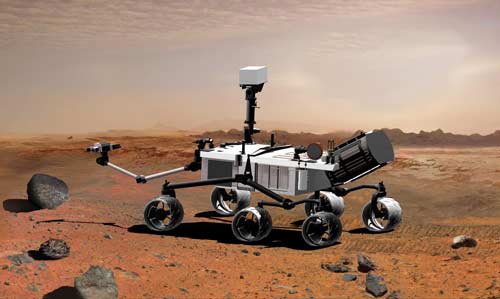
The Mars Science Laboratory (MSL) is a long-range, long-duration, roving mobile laboratory. Its name is Curiosity Rover. It is part of NASA’s Mars Exploration Program. It was launched on 26 November, 2011 and landed in Gale Crater on 6 August, 2012. It continues to study the martian geology from the surface of Mars.

Curiosity’s First Scoop & Mars Bright Object.
On the mission’s 61st Martian day (sol) (7 Oct, 2012) NASA’s Mars rover Curiosity used its soil scoop for the first time, collecting a scoopful of sand and powdery material at the ‘Rocknest’ site.
The bright object visible on the ground (circled in red) was seen in one of the scoop photos and is believed to be something from the mars rover hardware, not Martian material.
The Mars Science Laboratory rover has six wheels and cameras mounted on a mast. It is twice as long and three times as heavy as the Mars Exploration Rovers Spirit and Opportunity. It is nearly the size of a Volkswagen Beetle. The rover is capable of reaching a destination that is 20 to 40 kms (12 to 24 miles) long, about the size of a small crater or wide canyon and three to five times smaller than previous landing zones on Mars.
NASA’s Jet Propulsion Laboratory (JPL), Pasadena, California manages the Mars Science Laboratory Project.

Curiosity Rover – Robot Geologist and Chemist in One!
The Mars Science Laboratory operates under its own power, nuclear power source. It generates electricity to power the science instruments and other systems and allows the rover to operate at higher and lower latitudes than those that might be traversed by a similarly equipped rover dependent on solar and battery power.
The aim of the mission is:
1. To examine martian rocks and soils in greater detail than ever before in order to understand the geologic processes that formed and modified them.
2. To collect and crush martian rock and soil samples and distribute them to on-board test chambers for chemical analysis. It will carry a suite of scientific instruments to identify organic compounds such as proteins and amino acids and assess Planet Mars as a potential habitat for microbial life, in the past or present.
3. To study the martian atmosphere and determine the distribution and circulation of water and carbon dioxide, whether frozen, liquid or gaseous. To identify features such as atmospheric gases that may be associated with biological activity.

MSL was delivered by next-generation landers using precision landing systems. In the final minutes before touchdown, the spacecraft activated its parachute and retro rockets before lowering the rover package to the Mars Surface on a tether (similar to the way a skycrane helicopter moves a large object).
The landing site of the Mars Science Laboratory mission was Gale Crater, Mars.
MSL was expected to remain active after landing for at least one Mars year (687 Earth days – two Earth years). As of July 2016 it is still active. NASA selected the Gale Crater landing site on the basis of highly detailed images sent to Earth by the Mars Reconnaissance Orbiter and in addition to data from previous mars missions.

NASA Curiosity Rover Team Select 1st Driving Destination.
The journey to Glenelg will send the rover 400 m (1,300 ft) east-southeast of its landing site. One of the three types of terrain intersecting at Glenelg is layered bedrock, which is attractive as the first drilling target.
Specs:
The Curiosity rover is 30m (10 ft) in length and weighs 900 kg (1,984 lb) including 80kg (176 lb) of scientific instruments.
Curiosity is 5 times as large and carry more than 10 times the mass of scientific instruments as the Mars Exploration Rovers Spirit or Opportunity.
History
* In April 2004, NASA made an ‘Announcement of Opportunity’ for proposals/ideas for science instruments that could be used onboard the Mars Science Laboratory.
* In late 2004 Aerojet test-fired a Viking flight spare rocket engine assembly in order to help design a new engine which will deliver the Mars Science Laboratory rover to the surface of Mars. The rocket engine used in the test was originally built, tested and delivered in 1973 for the Viking program. The engine was put into storage after the successful landing of the Viking 1 and Viking 2 spacecraft on Mars in 1976.
Aerojet under contract with NASA’s Jet Propulsion Laboratory, received the engine for five hot fire tests that were conducted to evaluate engine capabilities as well as general health checks. The hot fire tests determined that the key elements and features within the Viking engine are relevant to and meet the requirements of NASA’s Mars Science Laboratory mission.
Aerojet is building three new 700 pound thrust monopropellant rocket engine assemblies to further evaluate design changes in order to increase mission flexibility and life capability.
* On 14 December, 2004, NASA selected eight proposals to provide instrumentation and associated science investigations for the mobile Mars Science Laboratory (MSL) rover. The selected proposals conducted preliminary design studies to focus on how the instruments could be fitted into the mobile platform and delivered on schedule.
* It was originally scheduled for launch in December 2009 and to arrive in October 2010.
* On 22 July, 2011 NASA announced that Gale Crater had been selected as the landing site of the Mars Science Laboratory mission.
* First Australian tweetup for Mars mission: Selected members of the general public used Twitter to ask questions from scientists and report on this MSL’s mission to Mars. The “tweetup” was tied to the launch of the NASA mission and was being hosted by CSIRO’s Canberra Deep Space Communication Complex (CDSCC).
* On Saturday 19 November 2011, the launch of the Atlas V was delayed by one day to allow time for the team to remove and replace a flight termination system battery. The launch was rescheduled for Saturday, 26 November from Space Launch Complex-41 at Cape Canaveral Air Force Station, Florida. There was a one hour and 43 minute launch window at 10:02 a.m. EST.
* Liftoff was on time at 10:02 a.m. EST on 26 November 2011 from Space Launch Complex 41 on Cape Canaveral Air Force Station in Florida. It was scheduled to arrive at Mars on 6 August, 2012
* ‘Curiosity’ lands on Mars
Mars Landing – NASA’s Mars Science Laboratory spacecraft aka Curiosity Rover landed on Mars at 1:31am EDT on Monday, 6 August, 2012.
* After an 8 month journey, Curiosity is touched down in the 154 km wide Gale Crater in the red planet’s Elysium Planitia region.
* NASA Curiosity Rover Team Select 1st Driving Destination: Glenelg. The choice was described by Curiosity Project Scientist John Grotzinger of the California Institute of Technology during a media teleconference on 17 August, 2012.
* On Saturday night, 18 August 2012, ChemCam is expected to ‘zap’ its first rock in the name of planetary science. It will be the first time such a powerful laser has been used on the surface of another world.
The selected investigations and principal investigators were:
1. Mast Camera, Michael Malin, Malin Space Science Systems (MSSS), San Diego, California.
Mast Camera performed multi-spectral, stereo imaging at lengths ranging from kilometers to centimeters and acquired compressed high-definition video at 10 frames per second without the use of the rover computer.
2. ChemCam: Laser Induced Remote Sensing for Chemistry and Micro-Imaging, Roger Wiens, Los Alamos National Laboratory, Los Alamos, New Mexico.
ChemCam uses laser beams that can blast a rock from up to 10 metres away, vaporizing a small amount of the underlying mineral and then collecting the light emitted by the vaporized rock to see what it’s made of.
France provided ChemCam’s laser and telescope.
3. MAHLI: MArs HandLens Imager for the Mars Science Laboratory, Kenneth Edgett, MSSS.
MAHLI images rocks, soil, frost and ice at resolutions 2.4 times better and with a wider field of view, than the Microscopic Imager on the Mars Exploration Rovers.
4. Alpha-Particle-X-ray-Spectrometer for Mars Science Laboratory (APXS), Ralf Gellert, Max-Planck-Institute for Chemistry, Mainz, Germany.
APXS determines elemental abundance of rocks and soil. APXS was provided by the Canadian Space Agency.
5. CheMin: An X-ray Diffraction/X-ray Fluorescence (XRD/XRF) instrument for definitive mineralogical analysis in the Analytical Laboratory of MSL, David Blake, NASA’s Ames Research Center, Moffett Field, California.
CheMin identifies and quantifies all minerals in complex natural samples such as basalts, evaporites and soils, one of the principle objectives of Mars Science Laboratory.
6. Radiation Assessment Detector (RAD), Donald Hassler, Southwest Research Institute, Boulder, Colorado.
RAD characterises the broad spectrum of radiation at the surface of Mars. The data collected is useful in determining how future human crews can cope with radiation doses during their stays on Mars. RAD was funded by the Exploration Systems Mission Directorate at NASA Headquarters.
7. Mars Descent Imager, Michael Malin, MSSS.
Mars Descent Imager produced high-resolution color-video imagery of the MSL descent and landing phase, providing geological context information, as well as allowing for precise landing-site determination.
8. Sample Analysis at Mars with an integrated suite consisting of a gas chromatograph mass spectrometer, and a tunable laser spectrometer (SAM), Paul Mahaffy, NASA’s Goddard Space Flight Center, Greenbelt, Maryland.
SAM performed mineral and atmospheric analyses and used to detect a wide range of organic compounds and perform stable isotope analyses of organics and noble gases.
MSL also carried a pulsed neutron source and detector for measuring hydrogen (including water). It was provided to NASA through a co-operative agreement by the Russian Federal Space Agency. The project also included a meteorological package and an ultraviolet sensor provided by the Spanish Ministry of Education and Science.
The total cost of the Mars Science Laboratory project is about US$2.5 billion.
Mars Science Laboratory was successful and has paved the way for future Martian surface and sample return spacecraft.
Did you know?
For the first time since the Viking Landers, the minivan-sized MSL rover bought an analytical laboratory to the martian surface.
MSL was the next logical step beyond the twin Spirit and Opportunity rovers.
Curiosity’s radioisotope thermoelectric generator is 1st to space made entirely with Russian plutonium.
Books:
Mars: The Inside Story of the Red Planet by Heather Couper and Nigel Henbest
from Amazon.co.uk
The Smithsonian Book of Mars by Joseph M. Boyce
from Amazon.com, Amazon.co.uk
Mapping Mars: Science, Imagination, and the Birth of a World by Oliver Morton
from Amazon.com, Amazon.co.uk
Mars Science Laboratory Links
- Aerojet Propulsion Helps Land Mars Science Laboratory:
- Mars Exploration: Missions: Picture Source
- Mars Science Laboratory Website: – Mars Home – NASA
- NASA Selects Investigations for the Mars Science Laboratory: Press Release – Decemeber 14, 2004
- NASA Curiosity Team Pinpoints Site for First Drive: NASA MSL News – 17 Aug 2012
- View of Curiosity’s First Scoop Also Shows Bright Object: Image credit: NASA/JPL-Caltech/MSSS
- Where is Curiosity? – check here to see if Mars Science Laboratory is still active.
Any comments or suggestions, then click on Contact Info.


 is a long-range, long-duration, roving mobile laboratory . It is part of NASA’s Mars Exploration Program.)
You must be logged in to post a comment.